High security · Toronto
Safe Opening & Combination Change
The pharmacy's drop safe has a keypad that finally lost power for good, and the little override key that was supposed to live behind the counter cannot be found anywhere.
In plain words
A safe opening and combination change service is built around confirming who has the right to be inside the safe before any tool touches it. Once that is settled, the locksmith identifies the safe's make, model and lock type, then works through the least invasive method that fits it, whether that means reading a dial by feel or resetting an electronic keypad. The final step sets a new combination chosen by the current owner, tested repeatedly, so the visit ends with a working safe under a code only they hold.
How the visit goesThe bookkeeper who set the office safe's code retired in a hurry, and the float cash for tomorrow's registers is sitting behind a keypad nobody else in the building can operate.
Safe Opening & Combination Change
How the visit goes
Mechanical dial or electronic keypad?
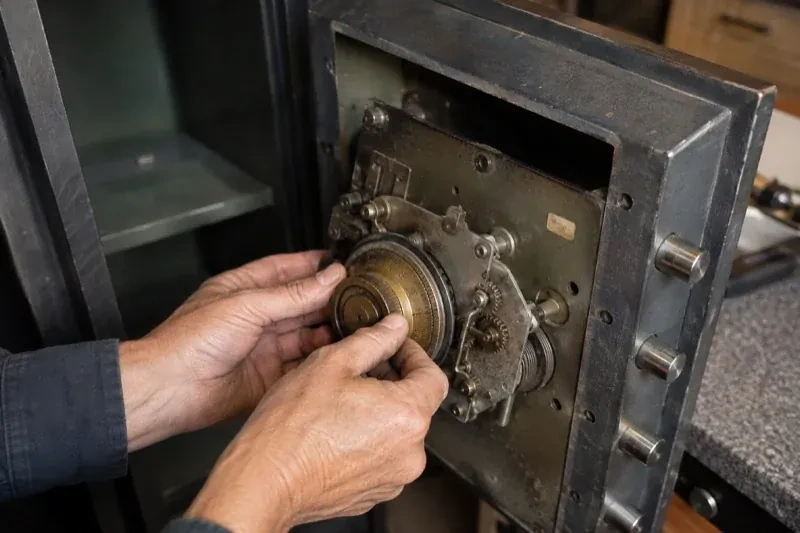
The two lock families are opened in entirely different ways, so telling them apart comes early. A mechanical dial relies on a wheel pack turned into alignment by hand, reading resistance and feel rather than any battery or circuit. An electronic keypad instead depends on a stored code and a power source; some models add a reset or override sequence, though many need that connection made at the lock body inside the container rather than from outside. Some commercial safes carry both, a keypad for daily use with a mechanical dial as a backup, and each half is assessed on its own terms. Confusing the two wastes time trying an approach the lock was never built to respond to.
Drilling through a chosen, repairable point
When manipulation, decoding and the electronic reset path all fail to open the safe, drilling is explained to the owner before it begins, aimed at a specific point the lock manufacturer's own service documentation identifies as both reachable and safe to repair afterward. A borescope is used through the drilled hole to view the lock's internal parts directly and manipulate or bypass them without further damage. The aim is to affect nothing beyond that single hole, patched or plugged as one of the last steps of the visit, though the number of holes needed and any effect on the safe's rated protection level depends on its construction and is addressed with the manufacturer's approved repair method.
Giving more than one person a way in
Many electronic locks support more than one user code, which means a manager and a designated backup employee can each be set up with their own working code during the same visit, rather than the business depending on a single person again. A mechanical dial cannot offer separate codes the same way, but a documented plan for who holds the combination and how it changes when staff do serves the same purpose. Either way, the point is the same: this reset should be the last one caused by a single departure catching everyone else by surprise.
Safe Opening & Combination Change
In the van
Repair plug and patch plate
Combination change key
Replacement dial and ring
Spindle and drive cam
Manipulation and tension tools
Safe Opening & Combination Change
What affects the quote
Multiple safes or vaults at one site
A property with more than one safe, such as a retail floor safe and a separate office unit, is quoted as a longer visit covering each one in turn.
Damage from a prior break-in attempt
Pry marks, drill attempts or a tripped relocker from an earlier incident mean assessing and repairing that damage in addition to the combination work the visit was booked for.
Replacement lock or hardware needed
If the existing lock is worn out, damaged, or simply outdated, a replacement mechanical or electronic lock adds to the visit, priced separately from the opening itself.
What to have ready
- Does the keypad light up or make sounds when pressed?
- Do you own the safe, or manage it for someone else?
- Who besides you should have the new combination afterward?
Safe Opening & Combination Change: questions
QuestionsCan several employees each get their own code once the safe is open?
Many electronic locks support more than one user code, so a manager and one or more backup employees can each be set up separately during the same visit rather than sharing a single combination. A mechanical dial only holds one combination at a time, so multiple access there means agreeing who holds it and how that changes when staff do.
Can a safe be repaired instead of replaced after drilling?
Often, yes, particularly for a mechanical lock, where a worn wheel pack, drive cam or spindle can be replaced individually within the existing lock body. An electronic lock's circuit board and keypad are less often repairable in place and are more commonly swapped for a comparable or higher-rated replacement unit that fits the same cutout.
How often should a safe combination be changed?
There is no fixed schedule; the sensible trigger is a change in who knows it, such as an employee or manager leaving, rather than a set number of months or years. A combination that has only ever been known to current staff generally does not need changing on a routine basis, since the lock itself does not wear out from correct use the way a mechanical part might.